Cancer Heterogeneity and Plasticity ISSN 2818-7792
Cancer Heterogeneity and Plasticity 2026;3(3):0012 | https://doi.org/10.47248/chp2603030012
Perspective Open Access
The Differentiation Paradox: Drug-Tolerant Persistence and Resistance Without Genetic Escape in IDH-Mutant Glioma
Laila Alkhouli
1

 ,
Andrew Dhawan
2,3,4
Correspondence: Andrew Dhawan
Academic Editor(s): Dean G. Tang, Toru Kondo
Received: Jun 6, 2026 | Accepted: Sep 8, 2026 | Published: Sep 14, 2026
Cite this article: Alkhouli L, Dhawan A. The Differentiation Paradox: Drug-Tolerant Persistence and Resistance Without Genetic Escape in IDH-Mutant Glioma. Cancer Heterog Plast. 2026;3(3):0012. https://doi.org/10.47248/chp2603030012
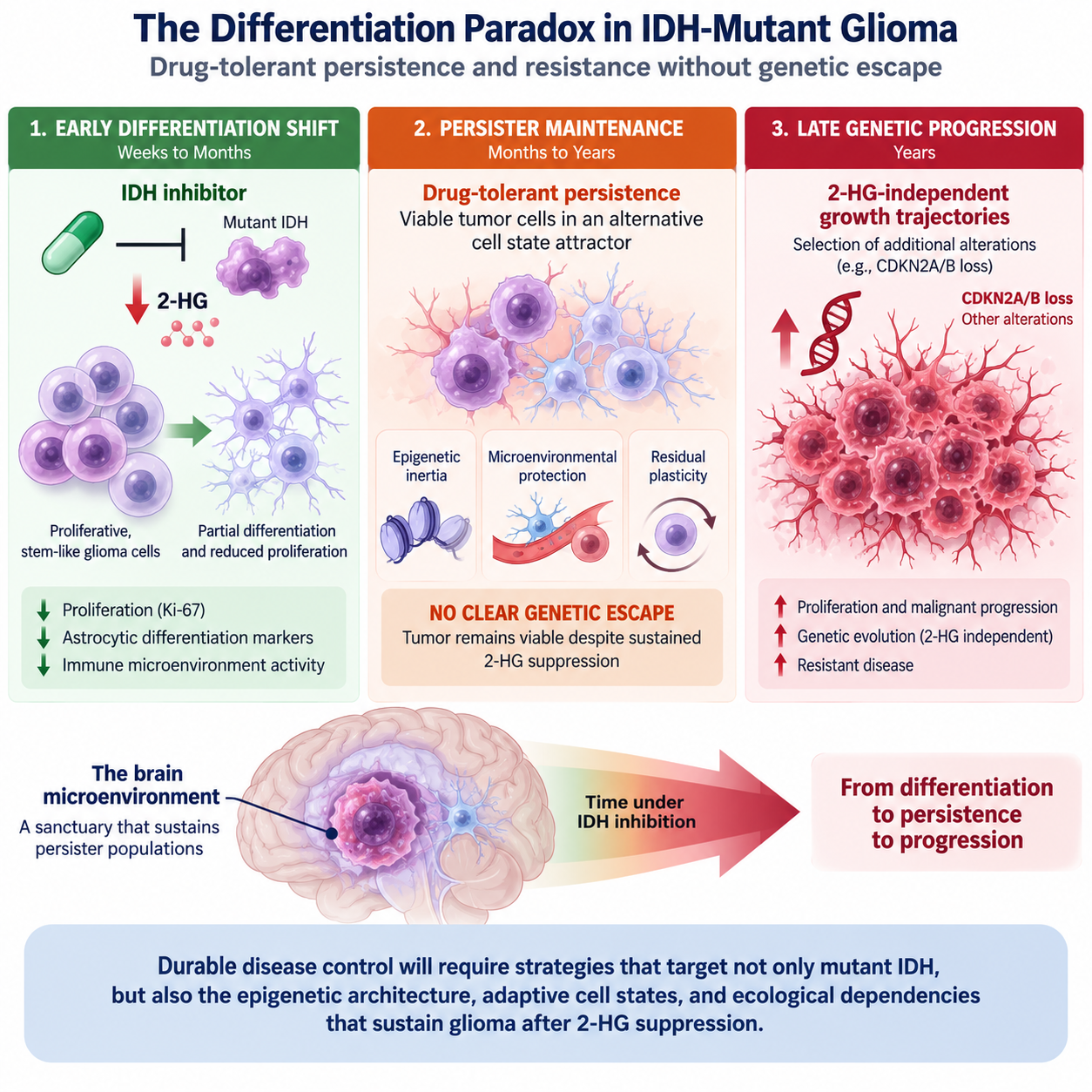
Mutant isocitrate dehydrogenase (IDH) inhibitors have added a much-needed treatment option for patients with diffuse low-grade glioma, yet they do not eradicate disease. In contrast to canonical models of targeted-therapy resistance in oncology, in which relapse is frequently driven by secondary mutations in the drug target or restoration of pathway output, progression in IDH mutant glioma often occurs in the absence of clear genetic escape at the level of mutant IDH itself. This discrepancy suggests that the dominant biology of treatment failure in glioma is not adequately captured by classical pharmacologic resistance paradigms. Here, we propose that progression under IDH inhibition is best understood as a layered and temporally structured process of non-genetic persistence, ecological protection, and eventual evolutionary divergence. Central to this framework is the concept of a differentiation paradox: suppression of 2-hydroxyglutarate by mutant IDH inhibition induces partial lineage differentiation and attenuates proliferation, yet leaves behind a viable tumor population stabilized in an alternative cell state attractor rather than eliminated through terminal differentiation or cell death. We introduce the concept of epigenetic inertia to describe the delayed and potentially asymmetrical reversal of 2-HG-driven chromatin states, permitting the persistence of stemness, survival, and plasticity programs, despite sustained metabolic target engagement. We further argue that the brain microenvironment functions as a sanctuary for these residual populations and that late-emerging alterations such as CDKN2A/B loss represent not primary escape from IDH inhibition, but the eventual selection of 2-HG-independent growth trajectories. On this basis, we propose a three-phase model of response and progression under IDH inhibition comprising an early differentiation shift, an intermediate persister maintenance phase, and late genetic progression. This framework has direct therapeutic implications and suggests that durable disease control will require strategies that target not only mutant IDH, but also the epigenetic architecture, adaptive cell states, and ecological dependencies that sustain glioma after 2-HG suppression.
KeywordsIDH-mutant glioma, vorasidenib, drug-tolerant persistence, epigenetic inertia, tumor microenvironment, adaptive resistance
Share this article




Copyright © 2026 Pivot Science Publications Corp. - unless otherwise stated | Terms and Conditions | Privacy Policy