Cancer Heterogeneity and Plasticity ISSN 2818-7792
Cancer Heterogeneity and Plasticity 2026;3(3):0012 | https://doi.org/10.47248/chp2603030012
Perspective Open Access
The Differentiation Paradox: Drug-Tolerant Persistence and Resistance Without Genetic Escape in IDH-Mutant Glioma
Laila Alkhouli
1

 ,
Andrew Dhawan
2,3,4
Correspondence: Andrew Dhawan
Academic Editor(s): Dean G. Tang, Toru Kondo
Received: Jun 6, 2026 | Accepted: Sep 8, 2026 | Published: Sep 14, 2026
© 2026 by the author(s). This is an Open Access article distributed under the Creative Commons License Attribution 4.0 International (CC BY 4.0) license, which permits unrestricted use, distribution and reproduction in any medium or format, provided the original work is correctly credited.
Cite this article: Alkhouli L, Dhawan A. The Differentiation Paradox: Drug-Tolerant Persistence and Resistance Without Genetic Escape in IDH-Mutant Glioma. Cancer Heterog Plast. 2026;3(3):0012. https://doi.org/10.47248/chp2603030012
Mutant isocitrate dehydrogenase (IDH) inhibitors have added a much-needed treatment option for patients with diffuse low-grade glioma, yet they do not eradicate disease. In contrast to canonical models of targeted-therapy resistance in oncology, in which relapse is frequently driven by secondary mutations in the drug target or restoration of pathway output, progression in IDH mutant glioma often occurs in the absence of clear genetic escape at the level of mutant IDH itself. This discrepancy suggests that the dominant biology of treatment failure in glioma is not adequately captured by classical pharmacologic resistance paradigms. Here, we propose that progression under IDH inhibition is best understood as a layered and temporally structured process of non-genetic persistence, ecological protection, and eventual evolutionary divergence. Central to this framework is the concept of a differentiation paradox: suppression of 2-hydroxyglutarate by mutant IDH inhibition induces partial lineage differentiation and attenuates proliferation, yet leaves behind a viable tumor population stabilized in an alternative cell state attractor rather than eliminated through terminal differentiation or cell death. We introduce the concept of epigenetic inertia to describe the delayed and potentially asymmetrical reversal of 2-HG-driven chromatin states, permitting the persistence of stemness, survival, and plasticity programs, despite sustained metabolic target engagement. We further argue that the brain microenvironment functions as a sanctuary for these residual populations and that late-emerging alterations such as CDKN2A/B loss represent not primary escape from IDH inhibition, but the eventual selection of 2-HG-independent growth trajectories. On this basis, we propose a three-phase model of response and progression under IDH inhibition comprising an early differentiation shift, an intermediate persister maintenance phase, and late genetic progression. This framework has direct therapeutic implications and suggests that durable disease control will require strategies that target not only mutant IDH, but also the epigenetic architecture, adaptive cell states, and ecological dependencies that sustain glioma after 2-HG suppression.
KeywordsIDH-mutant glioma, vorasidenib, drug-tolerant persistence, epigenetic inertia, tumor microenvironment, adaptive resistance
IDH1 and IDH2 somatic mutations are entity-defining molecular lesions under the 2021 WHO Classification of Tumors of the Central Nervous System, required for the diagnosis of adult-type diffuse astrocytoma and oligodendroglioma [1,2]. These gain-of-function mutations confer neomorphic enzyme activity on IDH, resulting in the production of the oncometabolite D-2-hydroxyglutarate (2-HG), which competitively inhibits α-ketoglutarate-dependent dioxygenases, including TET family DNA demethylases and Jumonji-domain histone demethylases, establishing the glioma CpG island methylator phenotype (G-CIMP) and a broad program of epigenetic dysregulation [3–5]. The clinical development of pharmacologic inhibitors targeting mutant IDH has culminated in the FDA approval of vorasidenib, a brain-penetrant dual IDH1/IDH2 inhibitor, for grade 2 IDH-mutant glioma following the landmark INDIGO trial, which demonstrated a progression-free survival of 27.7 months versus 11.1 months with placebo (HR 0.39) [6-7].
Despite this therapeutic advance, IDH-mutant gliomas are not cured by IDH inhibition, and the clinical implications of this advance must be interpreted with precision. IDH inhibition produces disease control rather than disease extinction. Radiographic responses are typically characterized by stabilization and gradual shrinkage rather than rapid cytoreduction, and progression is ultimately expected [7]. These kinetics are biologically informative and imply that IDH inhibition does not disable an indispensable survival pathway. Rather, it appears to reprogram tumor behavior, shifting growth dynamics and cell state composition without fully eliminating malignant potential. The central question, therefore, is not merely why IDH inhibitors eventually fail, but what kind of failure they represent.
In IDH-mutant acute myeloid leukemia (AML), acquired resistance to IDH inhibitors has been well characterized through genetic mechanisms: second-site mutations at the dimer interface that disable allosteric inhibition, and isoform switching from mutant IDH1 to mutant IDH2 or vice versa, restoring 2-HG production [8–10]. These mechanisms preserve the core oncogenic output of the pathway and therefore fit a familiar model of on-target escape. Diffuse glioma, however, may obey a different logic. It is a slow growing, spatially dispersed, and developmentally plastic tumor, embedded within the highly specialized microenvironment of the central nervous system. Its malignant phenotype is sustained not only by oncogenic signaling, but also by durable epigenetic architecture, lineage-state disequilibrium, and niche-dependent survival. In this context, progression under IDH inhibition may be driven less by continued dependence on mutant IDH function than by the persistence and evolution of tumor cell states that no longer require continuous 2-HG production to remain viable.
This review proposes that resistance to IDH inhibition in diffuse glioma may be better understood as a problem of incomplete reprogramming rather than simple target escape. We hypothesize that treatment failure emerges from the interaction of four processes: partial and non-terminal differentiation, persistent epigenetic memory, microenvironmental protection of residual disease, and eventual acquisition or selection of genetic alterations that confer 2-HG-independent proliferative fitness. This model places cell-state dynamics at the center of therapeutic response and suggests that the most consequential effect of IDH inhibition may be not tumor eradication, but displacement of the tumor into a less proliferative yet still evolutionarily competent state. We note at the outset that this framework is largely hypothesis-generating: the mechanistic evidence in glioma derives primarily from preclinical models and small translational cohorts, and the proposed model is intended as a testable conceptual scaffold rather than an established biological mechanism.
The Waddington epigenetic landscape provides a useful conceptual framework for understanding the biology of IDH-mutant glioma under therapy. In its classical formulation, the landscape depicts cell-fate determination as a ball rolling through a topography of branching valleys (attractors defined by the underlying gene regulatory network) separated by ridges [11,12]. In cancer, this metaphor has been extended to describe malignant attractors, aberrant but stable phenotypic states sustained by oncogenic and epigenetic perturbation rather than normal developmental cues [11,12].
IDH-mutant gliomas are particularly amenable to this framework because mutant IDH does not simply activate a signaling cascade; it reconfigures the epigenetic landscape on which cell identity is stabilized. Through chronic 2-HG production, mutant IDH alters DNA and histone methylation, reshaping the topography of accessible states [13]. The result appears to be the stabilization of a stem-like or progenitor-like attractor state, characterized by impaired differentiation, sustained plasticity, and continued proliferation [14,15]. In this view, mutant IDH deepens the basin of a malignant developmental arrest [11,16].
Pharmacologic inhibition of mutant IDH perturbs this landscape. By suppressing 2-HG, the drug reduces the forces maintaining the stem-like attractor and increases access to differentiation-associated states. However, the therapeutic perturbation does not restore a normal developmental landscape in any simple or symmetrical sense. The epigenetic architecture of the tumor has been shaped over years, perhaps decades, and the resulting topology may not be fully reversible. Consequently, the cell population may move from one malignant basin into another quasi-stable state that is less proliferative but still viable. If this model is correct, the relevant therapeutic outcome is not binary survival/death, but state transition without extinction [12,17].
This perspective helps explain the distinctive clinical behavior of IDH inhibitors in glioma. If the dominant effect of therapy is to redistribute cells across the landscape rather than eliminate them, then tumor shrinkage will be gradual, residual disease will persist, and progression may reflect the long-term evolutionary consequences of occupying a new attractor rather than immediate pharmacologic failure. In dynamical-systems terms, the drug does not push the tumor over a cliff; it redirects it into a neighboring valley. The challenge is that this new valley may still support persistence, plasticity, and eventual re-expansion [12,16,17].
Perioperative and translational studies have established that mutant IDH inhibition in glioma achieves robust biochemical target engagement. In the phase 1 perioperative trial of vorasidenib and ivosidenib, treatment for four weeks prior to surgical resection reduced tumor 2-HG concentrations by more than 90%, providing evidence that these agents effectively suppress the defining metabolic output of mutant IDH in human glioma tissue [15]. This biochemical effect was accompanied by increased DNA 5-hydroxymethylcytosine (5hmC), indicating reversal of TET enzyme inhibition [15,18], downregulation of stemness-associated programs, induction of neural differentiation signatures, reduced proliferative fraction, and evidence of immune remodeling, including increased T cell infiltration and type I interferon signaling [15,18,19].
Single-cell RNA analyses have been informative, though based on limited sample sizes to date. In a study of three IDH-mutant oligodendrogliomas treated with IDH inhibitors, Spitzer et al. showed that treatment depleted stem-like populations and promoted differentiation toward an astrocytic-like lineage [14]. This observation is mechanistically important as it indicates that the principal action of these drugs may be to alter developmental identity rather than directly induce apoptosis, and that response may depend on the latent capacity of tumor cells to undergo lineage transition once the 2-HG-imposed block is relieved. The authors also showed that NOTCH1-mutant tumors exhibited reduced astrocytic differentiation, further supporting this interpretation, and implying that co-occurring genomic lesions can shape the depth of reprogramming achieved under therapy [14].
More recently, Drummond et al. conducted a perioperative trial of safusidenib (DS-1001b) in 10 treatment-naive patients with IDH1-mutant low-grade glioma, providing a larger and clinically distinct validation cohort [20]. This study confirmed on-target 2-HG suppression and associated alterations in differentiation programs, corroborating the Spitzer et al. findings with a different IDH inhibitor in treatment-naive rather than previously treated patients. Notably, Drummond et al. also identified changes in neural excitability programs, validated by patch-clamp electrophysiology, suggesting that the cell-state consequences of IDH inhibition extend beyond the astrocytic lineage shift and may include modulation of neuronal-like functional properties. This adds an additional dimension to the differentiation response that the current model should accommodate: IDH inhibition may not simply push cells toward astrocytic differentiation but may also alter their functional integration with the neural microenvironment.
Preclinical models have converged on the same conclusion. The mutant IDH1 inhibitor AGI-5198 induced demethylation of H3K9me3 and expression of gliogenic differentiation genes, while impairing growth of IDH1-mutant but not wild-type glioma cells [21]. Long-term administration of the IDH1 inhibitor DS-1001b in xenograft models partly reversed genome-wide DNA hypermethylation and modulated H3K4me3 at genes related to apoptosis, cell cycle arrest, and migration [5]. The consistency of these findings across systems supports a coherent biological model: IDH inhibitors suppress 2-HG, reduce proliferation, and induce differentiation, but they do not reliably drive terminal maturation or eliminate all malignant cell states.
More recently, larger-scale longitudinal studies have added nuance to this picture. Johnson et al. integrated single-nucleus transcriptomics, chromatin accessibility, and bulk sequencing from 75 temporally separated IDH-mutant gliomas across 35 patients and identified two major cell-state transition patterns at recurrence: reduced lineage differentiation with increased proliferative cells, associated with acquired genetic events, and increased mesenchymal-like state abundance, occurring independently of genetic alterations and instead coinciding with elevated macrophage infiltration [22]. Nomura et al. used joint single-nucleus DNA methylation and RNA sequencing on longitudinal samples from 19 patients and demonstrated that progressive DNA methylation loss underlies rather than merely accompanies the expansion of stem-like states during progression, reshaping cell-state heritability and plasticity [23]. These findings suggest that the cell-state consequences of IDH inhibition may be more complex than the astrocytic differentiation shift initially described, and that the epigenetic evolution of these tumors involves both the persistence of 2-HG-imposed marks and active methylation loss that increases cellular plasticity.
Although resistance classically denotes a singular mechanism of therapeutic escape, in IDH-mutant glioma, it may instead describe the cumulative outcome of several partially overlapping failures of reprogramming and eradication. Progression under therapy need not imply that the drug has ceased to inhibit mutant IDH. Rather, it may indicate that suppression of mutant IDH is insufficient to extinguish the biological systems that sustain the tumor. In this sense, resistance may be better conceptualized as multifocal treatment failure.
The first component of this failure is incomplete and aberrant differentiation. IDH inhibition clearly shifts tumor cells away from stem-like states, yet the resulting differentiated phenotype is not terminal. Cells acquire lineage-associated features and reduce proliferation, but they remain viable and, crucially, retain the capacity for persistence and further adaptation. This is what we term the differentiation paradox. In developmental biology, differentiation is often coupled to loss of proliferative potential and increasing restriction of fate. In glioma under IDH inhibition, by contrast, differentiation appears to be partial, non-terminal, and compatible with long-term survival. The therapeutic state may therefore be neither stem-like malignancy nor terminal differentiation, but an intermediate attractor that lowers immediate growth while preserving future evolutionary potential.
From this proposed intermediate state, cells could theoretically: (a) remain quiescent as drug-tolerant persisters; (b) undergo further differentiation if the epigenetic landscape continues to evolve under sustained IDH inhibition; (c) transition back toward a stem-like state if drug pressure is removed or if microenvironmental signals promote dedifferentiation; or (d) acquire genetic alterations that deepen a new malignant attractor and enable proliferative escape.
While stem-like cells are depleted and astrocytic differentiation markers increase, differentiation does not proceed to a terminally differentiated, post-mitotic state [14]. This creates what we term the “differentiation paradox”: partial differentiation reduces cancer cell proliferation but preserves a viable tumor population. The population settles into an intermediate differentiation state, a new attractor on the Waddington landscape, rather than undergoing the complete lineage commitment that would lead to proliferative exhaustion and eventual cell death.
This paradox is not unique to glioma. In IDH-mutant AML, enasidenib induces differentiation of leukemic blasts, and clinical responses are characterized by differentiation rather than cytotoxicity [24]. However, differentiation-based responses can be incomplete, and residual disease persists. In the glioma context, the diffuse infiltrative nature of the tumor and the supportive brain microenvironment may further stabilize these partially differentiated states.
The NOTCH1 dependency identified by Spitzer et al. adds another layer of complexity [14]. Tumors with NOTCH1 mutations show decreased astrocytic differentiation in response to IDH inhibition, suggesting that the differentiation response is genetically modified. This implies that even among IDH-mutant gliomas, the capacity for drug-induced differentiation, and therefore the depth of response, varies based on the co-mutational landscape.
A second component of treatment failure is persistent epigenetic memory. A critical limitation of IDH inhibitor therapy is that suppression of 2-HG does not immediately or completely reverse the epigenetic changes accumulated during years of oncometabolite exposure. Turcan et al. demonstrated that prolonged exposure to mutant IDH1 results in irreversible genomic and epigenetic alterations, establishing that there is a temporal threshold beyond which some chromatin changes become fixed [13]. Waitkus and Yan highlighted that epigenetic changes induced by 2-HG may persist even after mutant IDH activity is inhibited and 2-HG has returned to basal levels [3].
The kinetics of epigenetic reversal are instructive. In the TF-1 IDH2 R140Q erythroleukemia model, Kernytsky et al. showed that histone hypermethylation is rapidly reversed within days of IDH inhibition, whereas reversal of DNA hypermethylation proceeds progressively over weeks [24]. In glioma, where the G-CIMP phenotype has been established over years to decades of 2-HG exposure, the timescale for meaningful epigenetic reversal may be far longer, potentially exceeding the clinical window of drug efficacy.
We propose the term "epigenetic inertia" to describe this phenomenon: the lag between pharmacologic suppression of the oncometabolite and phenotypic change in the tumor cell population, arising from the persistence of chromatin accessibility patterns, DNA methylation marks, and histone modifications that were established under 2-HG pressure but are not immediately reversed upon its removal. This concept is supported by the observation that DS-1001b only partly reversed genome-wide DNA hypermethylation even with prolonged treatment, and that the epigenome of IDH-mutant gliomas evolves progressively over time, with treatment-associated loss of methylation occurring gradually rather than acutely [5,25].
If confirmed, epigenetic inertia would have profound implications. It would mean that even under effective 2-HG suppression, the chromatin landscape retains a "memory" of the malignant state. Active chromatin programs, including those governing self-renewal, survival signaling, and microenvironmental interactions may continue to operate, sustained by the inherited epigenetic configuration rather than by ongoing 2-HG production. This is consistent with the broader concept of epigenetic heritability of cell plasticity, wherein a "permissive epigenome" enables phenotypic plasticity and drug resistance through a one-to-many genotype-to-phenotype map [26].
A third component of treatment failure is microenvironmental protection. IDH-mutant gliomas exist within the unique microenvironment of the central nervous system, which provides protective niches that may sustain tumor cells independently of 2-HG-driven programs. The perivascular niche (PVN) has been identified as a preferential location for long-term quiescent glioma cells, and both the PVN and tumor microtube network integration facilitate resistance to radiotherapy and chemotherapy independently and additively [27].
The glioma microenvironment includes tumor-associated macrophages and microglia (GAMs), astrocytes, neurons, and the extracellular matrix, all of which engage in bidirectional signaling with tumor cells [28,29]. IDH-mutant gliomas characteristically show lower immune cell infiltration and reduced angiogenesis compared to IDH-wildtype tumors, but IDH inhibition itself may alter this landscape [29]. The perioperative trial data showed that 2-HG suppression increased T-cell infiltration and activated interferon signaling, suggesting that IDH inhibition partially reverses the immunosuppressive microenvironment [18,19]. However, this immune activation may be insufficient to eliminate residual tumor cells, particularly those sheltered in protective niches.
Astrocytes in the glioma microenvironment undergo phenotypic reprogramming and can provide metabolic support, promote immune suppression, and transfer mitochondria to tumor cells [30,31]. These interactions may sustain persister populations even when the primary oncogenic driver (2-HG) is suppressed. The concept of microenvironmental protection of drug-tolerant persister cells is well established across cancer types, and the brain, with its unique immune privilege, blood-brain barrier, and specialized cellular composition may represent a particularly effective sanctuary [32–34].
A fourth component emerges later in the disease course and involves genetic progression. While the early and intermediate phases of resistance may be predominantly non-genetic, eventual disease progression in IDH-mutant glioma is frequently accompanied by genetic alterations. The most clinically significant of these is homozygous deletion of CDKN2A/B, which encodes the cell cycle regulators p16INK4a and p15INK4b. CDKN2A/B homozygous deletion is the strongest independent adverse prognostic factor in IDH-mutant astrocytoma and is now sufficient to designate a tumor as WHO grade 4 regardless of histologic features [35–37].
Patients with CDKN2A/B-deleted IDH-mutant astrocytomas have dramatically worse outcomes: median overall survival of 4-5 years compared to 10–13.5 years for grade 4 tumors without CDKN2A/B deletion [37,38]. Additional genetic alterations associated with progression include PDGFRA amplification, CDK4 amplification, MYCN amplification, MET fusions, and PTEN deletion [39–42].
Critically, Drucker et al. described a two-phase model of IDH-mutant glioma progression: in early stages, tumors are driven by oligodendrocyte precursor-like cells and epigenetic alterations that silence tumor suppressors (including CDKN2A) and activate oncogenes (such as PDGFRA); as disease advances, more proliferative neural precursor-like cells emerge in which genetic alterations such as CDKN2A/B deletion, PDGFRA amplification, and CDK4 amplification drive progression [42]. This epigenetic-to-genetic shift is a key feature of glioma evolution and suggests that the genetic alterations observed at progression are not random events but rather the culmination of a process that was already underway during the persister phase.
This has important implications for understanding resistance to IDH inhibitors. The genetic changes that drive clinical progression (e.g., CDKN2A/B loss) may not represent escape from IDH inhibition per se, but rather the acceleration or unmasking of pre-existing evolutionary trajectories. The persister state maintained by epigenetic inertia and microenvironmental protection may provide the temporal window during which these genetic alterations could accumulate, although whether IDH inhibition actively promotes, passively permits, or has no effect on the acquisition of these alterations remains unknown.
The model presented above focuses on acquired resistance following initial disease control, but a clinically important subset of IDH-mutant gliomas do not respond to IDH inhibitors from the outset. In the INDIGO trial, approximately 17% of vorasidenib-treated patients experienced early radiographic progression, and enhancing (higher-grade) tumors showed consistently less benefit [6,7]. This de novo resistance suggests that some tumors have already transitioned beyond meaningful dependence on ongoing 2-HG production at the time of treatment initiation.
Within the Waddington framework, these tumors may already reside in a deep malignant attractor that IDH inhibition cannot dislodge. Several features could account for this: pre-existing CDKN2A/B homozygous deletion or other cell cycle alterations that render proliferation 2-HG-independent [35–37]; advanced methylation loss that has already reshaped cell-state plasticity beyond the point of reversibility [25]; or expansion of proliferative neural progenitor-like cells driven by genetic rather than epigenetic mechanisms, as described by Wu et al. [43] and Johnson et al. [22]. More broadly, the proposed model does not yet explain why some IDH-mutant gliomas lacking hallmark adverse genetic alterations still fail to respond. Identifying the molecular determinants of upfront resistance, whether epigenetic, microenvironmental, or related to co-mutations such as TP53 or ATRX status, remains a critical gap.
Drummond et al. similarly noted that while the perioperative approach demonstrated feasibility and on-target activity, the 10-patient cohort had a median follow-up of only 14 months, and long-term efficacy and resistance patterns remain to be characterized [20].
Integrating the concepts above, we propose a three-phase temporal model (Figure 1). In Phase 1, the early differentiation shift, which unfolds over weeks to months, initiation of IDH inhibitor therapy rapidly suppresses 2-HG levels (>90% reduction within weeks) [15]. This triggers partial reversal of TET inhibition, increased 5hmC, and the beginning of chromatin remodeling [18,24]. Stem-like cells begin to differentiate along astrocytic lineages, proliferation decreases, and the tumor enters a state of growth arrest or slow regression [7,14]. Clinically, this corresponds to the radiographic stabilization and gradual shrinkage observed in the INDIGO trial [7].

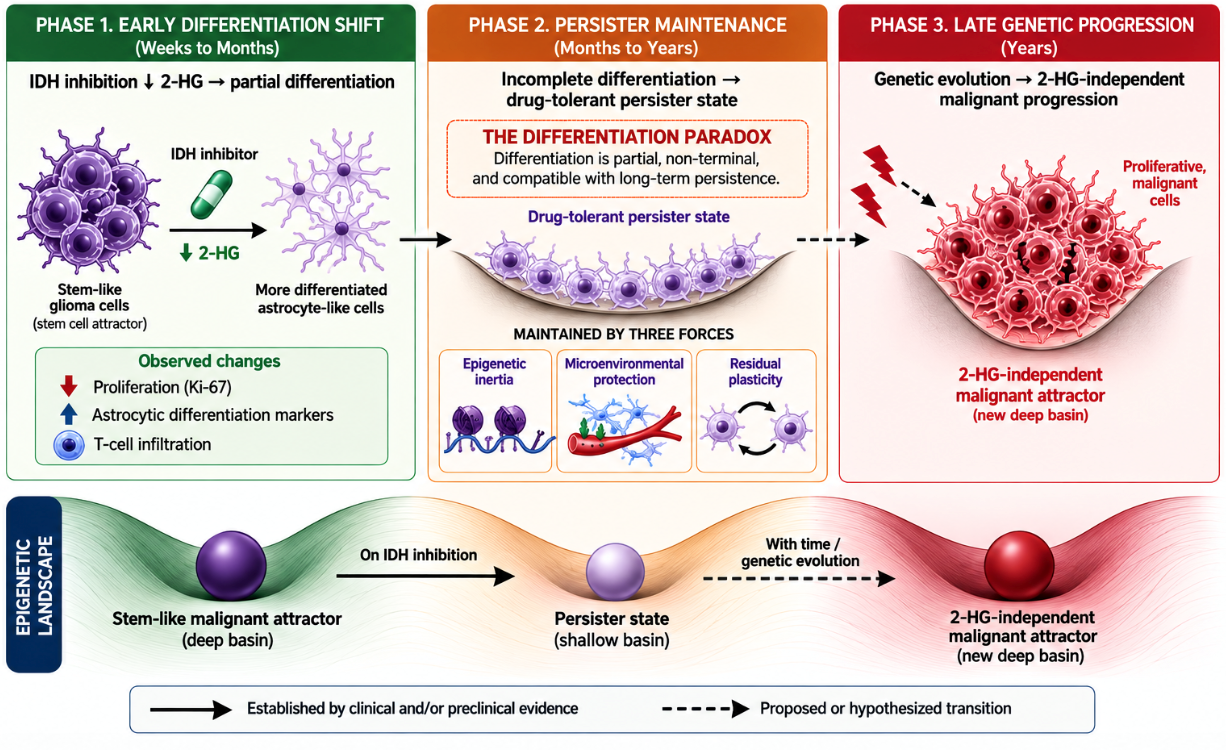
Figure 1. The Differentiation Paradox: Proposed Three-Phase Model of Response and Resistance to IDH Inhibition in IDH-Mutant Glioma. The Differentiation Paradox: Proposed three-phase model of response and resistance to IDH inhibition in IDH-mutant glioma. This conceptual model integrates available clinical and preclinical observations with hypothesized mechanisms of persistence and progression following mutant IDH inhibition. Phase 1 (Early Differentiation Shift): IDH inhibition suppresses 2-hydroxyglutarate (2-HG) and is associated with reduced proliferation and features of differentiation and immune microenvironment remodeling. Phase 2 (Persister Maintenance): We propose that incomplete or non-terminal differentiation may leave a viable, drug-tolerant persister population. Epigenetic inertia, microenvironmental protection, and residual cell-state plasticity are proposed as potential mechanisms contributing to persistence despite continued IDH inhibition. This represents the “differentiation paradox”: differentiation may reduce malignant proliferation without necessarily resulting in terminal differentiation or tumor eradication. Phase 3 (Late Genetic Progression): Over time, acquisition or selection of 2-HG-independent genetic alterations, including CDKN2A/B homozygous deletion, may enable proliferative escape and malignant progression. The conceptual epigenetic landscape illustrates the hypothesized evolution from a stem-like malignant state to an intermediate persister state and, ultimately, to a new 2-HG-independent malignant state.
In Phase 2, the persister-maintenance phase, which may last months to years, epigenetic inertia prevents complete reversal of the malignant chromatin state despite ongoing 2-HG suppression. Active chromatin programs, maintained by heritable DNA methylation patterns, histone modifications, and chromatin-accessibility configurations, may sustain a population of drug-tolerant persister cells [13,26,44]. These cells are slow-cycling but viable and are sheltered by the brain microenvironment through perivascular niches, astrocyte interactions, and relative immune privilege [27,29]. The tumor is clinically stable but not eradicated.
In Phase 3, the late genetic progression phase, which may emerge over years, the persister population accumulates or selects for genetic alterations such as CDKN2A/B homozygous deletion, PDGFRA amplification, and CDK4 amplification that confer proliferative advantages independent of 2-HG [35,39,40]. These alterations may have been present at low frequency before treatment or may arise de novo during the persister phase. The epigenetic-to-genetic transition described by Drucker et al. accelerates, and the tumor progresses clinically [39]. Importantly, this progression is not “resistance to IDH inhibition” in the narrow pharmacologic sense; the drug may still be suppressing 2-HG effectively, but the tumor may have shifted toward 2-HG-independent growth programs. Table 1 summarizes the proposed phases, supporting evidence, and therapeutic implications.
Table 1. Proposed Three-Phase Model of IDH Inhibitor Response and Resistance in Diffuse Glioma. This table summarizes the proposed temporal phases of response and resistance to mutant IDH inhibition in diffuse glioma, including the dominant biological processes, predicted cell states, representative supporting evidence, potential monitoring biomarkers, therapeutic implications for each phase and evidence level. This model is hypothesis-generating and intended to provide a conceptual framework for future investigation rather than a definitive mechanistic account. Abbreviations: 2-HG, D-2-hydroxyglutarate; 5hmC, 5-hydroxymethylcytosine; MRS, magnetic resonance spectroscopy; ctDNA, circulating tumor DNA; RT, radiotherapy; PDGFRA, platelet-derived growth factor receptor alpha.

The evidence discussed in this review derives from both IDH-mutant astrocytoma and oligodendroglioma, which share the IDH mutation and G-CIMP phenotype but differ in co-mutations, lineage organization, and routes of progression. Oligodendrogliomas are defined by 1p/19q codeletion and typically lack TP53 mutation and ATRX loss, whereas astrocytomas harbor TP53 and ATRX alterations. The Spitzer et al. data showing astrocytic differentiation under IDH inhibition came specifically from oligodendrogliomas [14]; whether astrocytomas undergo the same lineage shift remains unclear.
Johnson et al. found that malignant cell states displayed comparable chromatin accessibility profiles between both subtypes, suggesting shared cell-state architecture [22]. However, the genetic drivers of progression differ: CDKN2A/B homozygous deletion is the hallmark of grade 4 astrocytoma but is not used for grading oligodendroglioma [35–37]. The mesenchymal-like transition at recurrence may be more prominent in astrocytomas, where it has been linked to immune infiltration and microenvironmental remodeling [24,45]. The proposed three-phase model likely applies in its general architecture to both subtypes, but specific cell-state trajectories, the depth of differentiation achievable, and the genetic routes to progression may differ and should be investigated separately.
If resistance to IDH inhibition is multifocal rather than monogenic, then therapeutic strategies must address the ecosystem of the tumor rather than 2-HG alone. Several approaches merit consideration.
If epigenetic inertia sustains persister programs, then combining IDH inhibitors with agents that actively remodel chromatin may accelerate the reversal of malignant epigenetic states. BET inhibitors, which displace BRD4 from acetylated chromatin at superenhancers and oncogene promoters, have shown activity in glioma models [45,46]. HDAC inhibitors, which alter the histone acetylation landscape, synergize with BET inhibitors in glioblastoma [45,47]. Dual BET/HDAC inhibitors are under development [48]. The key challenge is CNS penetrance: most existing BET and HDAC inhibitors have limited blood-brain barrier permeability, and the development of brain-penetrant epigenetic agents is a priority [49,50]. The rationale is that by disrupting the chromatin programs that maintain the persister state, these agents could push partially differentiated cells toward terminal differentiation or apoptosis, deepening the valley on the Waddington landscape until the population cannot escape.
Given that CDKN2A/B loss is the most significant genetic driver of progression in IDH-mutant astrocytoma, targeting the cell cycle pathway, particularly CDK4/6, represents a logical combination strategy [35,36]. CDK4/6 inhibitors could address the downstream consequence of CDKN2A/B loss (unchecked CDK4/6-mediated Rb phosphorylation) and may be particularly relevant in tumors with hemizygous CDKN2A/B loss or early evidence of cell cycle dysregulation [40,42]. The timing of such combinations is critical: initiating cell cycle-targeted therapy during the persister phase, before frank genetic progression, could preempt the transition to Phase 3.
The immunomodulatory effects of IDH inhibition, increased T-cell infiltration, interferon signaling activation, and enhanced antigen presentation provide a rationale for combining IDH inhibitors with immunotherapy [18,19]. Preclinical data from Kadiyala et al. demonstrated that combining 2-HG inhibition with radiation/temozolomide and anti-PD-L1 achieved complete tumor regression in 60% of IDH-mutant glioma-bearing mice [19]. The observation that IDH inhibition upregulates PD-L1 on tumor cells suggests that the immune checkpoint axis becomes a relevant resistance mechanism under IDH inhibitor therapy, creating a therapeutic vulnerability for checkpoint blockade [19]. Beyond immunotherapy, disrupting the protective signals from the perivascular niche, tumor-associated astrocytes, and the extracellular matrix could reduce the sanctuary effect that sustains persister populations [27,28,30].
The drug-tolerant persister literature across cancer types suggests that intermittent or adaptive dosing strategies may prolong drug utility by preventing the stable fixation of resistant states [34,51,52]. Mathematical modeling has demonstrated that adaptive therapy, modulating drug dose based on tumor burden rather than administering continuous maximum-tolerated dose, can significantly delay progression by maintaining competition between sensitive and resistant populations [53–55].
In the context of IDH-mutant glioma, intermittent IDH inhibitor dosing could theoretically exploit the reversibility of the persister state: drug holidays might allow partially differentiated cells to revert toward a drug-sensitive stem-like state, which could then be re-targeted upon drug reinitiation. However, this strategy carries risks, particularly if drug withdrawal allows persister cells to re-expand or if the epigenetic landscape has shifted sufficiently that reversion is incomplete. Careful clinical investigation with longitudinal molecular monitoring (e.g., liquid biopsy for 2-HG levels, circulating tumor DNA) would be essential.
The framework presented here, resistance without genetic escape, the differentiation paradox, and epigenetic inertia, reframes the challenge of IDH inhibitor resistance in glioma as an ecological and epigenetic problem rather than a purely pharmacologic one. Several key questions remain, and the proposed model suggests specific approaches for addressing them.
First, the temporal threshold beyond which 2-HG-induced epigenetic changes become irreversible in human glioma must be defined. Longitudinal DNA methylation profiling through repeat biopsy or emerging methylation-based liquid biopsy platforms could track epigenetic reversal under IDH inhibitor therapy and identify patients in whom the malignant chromatin state is incompletely reversed.
Second, serial 2-HG measurement via MR spectroscopy could serve as a pharmacodynamic biomarker for Phase 1, while serial volumetric MRI with tumor growth rate kinetics may provide an early indicator of transition from Phase 2 to Phase 3.
Third, circulating tumor DNA analysis for CDKN2A/B deletion, PDGFRA amplification, and other progression markers could enable non-invasive detection of Phase 3 genetic progression before radiographic change.
Fourth, single-cell and spatial multi-omic profiling of longitudinal surgical samples, as demonstrated by Johnson et al. and Nomura et al. [22,23], could map cell-state evolution under IDH inhibitor therapy and identify the chromatin programs that sustain the proposed persister state.
Fifth, it remains unclear whether specific co-mutations (e.g., NOTCH1, TP53, ATRX) modify the depth and durability of IDH inhibitor-induced differentiation, and prospective correlative studies within IDH inhibitor trials should prioritize this question.
Sixth, the development of brain-penetrant epigenetic agents with acceptable safety profiles for long-term combination therapy in a young patient population remains a prerequisite for testing the epigenetic combination strategies discussed above.
Finally, the optimal sequencing and scheduling of IDH inhibitors relative to radiation, chemotherapy, and novel targeted agents remain to be defined through clinical investigation.
The approval of vorasidenib represents a watershed moment for IDH-mutant glioma, but it is the beginning rather than the end of the therapeutic journey. The slow natural history of these tumors, measured in years to decades, provides both a challenge and an opportunity: a challenge because resistance mechanisms operate over timescales that are difficult to study in clinical trials, and an opportunity because there is time to intervene at multiple points along the trajectory from diagnosis to progression. Treating the ecosystem of low-grade glioma, not just inhibiting 2-HG, will be essential to realizing the full potential of IDH-targeted therapy.
Not applicable.
Not applicable.
Not applicable.
The authors received no specific funding for this work.
Andrew Dhawan has served as a member of an advisory board for Servier. The other authors have declared that no competing interests exist.
Not applicable.
| 1 | Gatto L, Franceschi E, Tosoni A, Di Nunno V, Maggio I, Lodi R, et al. IDH Inhibitors and Beyond: The Cornerstone of Targeted Glioma Treatment. Mol Diagn Ther. 2021;25(4):457-473. [Google Scholar] [CrossRef] |
| 2 | Persico P, Lorenzi E, Losurdo A, Dipasquale A, Di Muzio A, Navarria P, et al. Precision Oncology in Lower-Grade Gliomas: Promises and Pitfalls of Therapeutic Strategies Targeting IDH-Mutations. Cancers (Basel). 2022;14(5):1125. [Google Scholar] [CrossRef] |
| 3 | Waitkus MS, Yan H. Targeting Isocitrate Dehydrogenase Mutations in Cancer: Emerging Evidence and Diverging Strategies. Clin Cancer Res. 2021;27(2):383-388. [Google Scholar] [CrossRef] |
| 4 | de Lima JAL, Lima LM. State of the Art of IDH Inhibitors: Emerging Questions and Perspectives. Anticancer Agents Med Chem. 2025;25. [Google Scholar] |
| 5 | Fujimoto K, Honda-Kitahara M, Hattori N, Matsushita Y, Hibiya Y, Satomi K, et al. Long-term administration of the mutant IDH inhibitor DS-1001b suppresses the growth of IDH1-mutant glioma in vitro and in mouse xenograft models and alters epigenetic profiles. Acta Neuropathol. 2026;151(1):15. [Google Scholar] |
| 6 | Mellinghoff IK, van den Bent MJ, Blumenthal DT, Touat M, Peters KB, Clarke J, et al. Vorasidenib in IDH1- or IDH2-Mutant Low-Grade Glioma. N Engl J Med. 2023;389(7):589-601. [Google Scholar] [CrossRef] |
| 7 | Cloughesy TF, van den Bent MJ, Touat M, Blumenthal DT, Peters KB, Ellingson BM, et al. Vorasidenib in IDH1-mutant or IDH2-mutant low-grade glioma (INDIGO): secondary and exploratory endpoints from a randomised, double-blind, placebo-controlled, phase 3 trial. Lancet Oncol. 2025;26(12):1665-1675. [Google Scholar] [CrossRef] |
| 8 | Lyu J, Liu Y, Gong L, Chen M, Madanat YF, Zhang Y, et al. Disabling Uncompetitive Inhibition of Oncogenic IDH Mutations Drives Acquired Resistance. Cancer Discov. 2023;13(1):170-193. [Google Scholar] [CrossRef] |
| 9 | Intlekofer AM, Shih AH, Wang B, Nazir A, Rustenburg AS, Albanese SK, et al. Acquired resistance to IDH inhibition through trans or cis dimer-interface mutations. Nature. 2018;559(7712):125-129. [Google Scholar] [CrossRef] |
| 10 | Harding JJ, Lowery MA, Shih AH, Schvartzman JM, Hou S, Famulare C, et al. Isoform Switching as a Mechanism of Acquired Resistance to Mutant Isocitrate Dehydrogenase Inhibition. Cancer Discov. 2018;8(12):1540-1547. [Google Scholar] [CrossRef] |
| 11 | Jia D, Jolly MK, Kulkarni P, Levine H. Phenotypic Plasticity and Cell Fate Decisions in Cancer: Insights from Dynamical Systems Theory. Cancers (Basel). 2017;9(7):70. [Google Scholar] [CrossRef] |
| 12 | Grunt TW. Understanding cancer from a biophysical, developmental and systems biology perspective using the landscapes-attractor model. Biosystems. 2025;247:105376. [Google Scholar] [CrossRef] |
| 13 | Turcan S, Makarov V, Taranda J, Wang Y, Fabius AWM, Wu W, et al. Mutant-IDH1-dependent chromatin state reprogramming, reversibility, and persistence. Nat Genet. 2018;50(1):62-72. [Google Scholar] [CrossRef] |
| 14 | Spitzer A, Gritsch S, Nomura M, Jucht A, Fortin J, Raviram R, et al. Mutant IDH inhibitors induce lineage differentiation in IDH-mutant oligodendroglioma. Cancer Cell. 2024;42(5):904-914.e9. [Google Scholar] [CrossRef] |
| 15 | Mellinghoff IK, Lu M, Wen PY, Taylor JW, Maher EA, Arrillaga-Romany I, et al. Vorasidenib and ivosidenib in IDH1-mutant low-grade glioma: a randomized, perioperative phase 1 trial. Nat Med. 2023;29(3):615-622. [Google Scholar] [CrossRef] |
| 16 | Barkley D, Rao A, Pour M, França GS, Yanai I. Cancer cell states and emergent properties of the dynamic tumor system. Genome Res. 2021;31(10):1719-1727. [Google Scholar] [CrossRef] |
| 17 | Su Y, Bintz M, Yang Y, Robert L, Ng AHC, Liu V, et al. Phenotypic heterogeneity and evolution of melanoma cells associated with targeted therapy resistance. PLoS Comput Biol. 2019;15(6):e1007034. [Google Scholar] [CrossRef] |
| 18 | Lu M, Cloughesy TF, Wen PY, Tassinari A, Choe S, Zhu D, et al. Impact of mutant IDH (mIDH) inhibition on DNA hydroxymethylation, tumor cell function, and tumor immune microenvironment (TIME) in resected mIDH1 lower-grade glioma (LGG). J Clin Oncol. 2021;39(15_suppl):2008. [Google Scholar] [CrossRef] |
| 19 | Kadiyala P, Carney SV, Gauss JC, Garcia-Fabiani MB, Haase S, Alghamri MS, et al. Inhibition of 2-hydroxyglutarate elicits metabolic reprogramming and mutant IDH1 glioma immunity in mice. J Clin Invest. 2021;131(4):e139542. [Google Scholar] [CrossRef] |
| 20 | Drummond KJ, Spiteri M, Cain SA, Jones J, Shaya S, Topp M, et al. Perioperative IDH inhibition in treatment-naive IDH-mutant glioma: a pilot trial. Nat Med. 2025;31(10):3451-3463. [Google Scholar] [CrossRef] |
| 21 | Rohle D, Popovici-Muller J, Palaskas N, Turcan S, Grommes C, Campos C, et al. An Inhibitor of Mutant IDH1 Delays Growth and Promotes Differentiation of Glioma Cells. Science. 2013;340(6132):626-630. [Google Scholar] [CrossRef] |
| 22 | Johnson KC, Spitzer A, Varn FS, Nomura M, Garofano L, Chowdhury T, et al. Acquired genetic and cell-state changes in IDH-mutant glioma progression. Nature. 2026;655(8124):1048-1059. [Google Scholar] [CrossRef] |
| 23 | Nomura M, Raviram R, Schiffman JS, Bussema L, Lu V, Wheeler N, et al. Longitudinal changes in DNA methylation in IDH-mutant glioma fuel disease progression through altered cell state differentiation. Nat Genet. 2026;58(7):1651-1660. [Google Scholar] [CrossRef] |
| 24 | Kernytsky A, Wang F, Hansen E, Schalm S, Straley K, Gliser C, et al. IDH2 mutation-induced histone and DNA hypermethylation is progressively reversed by small-molecule inhibition. Blood. 2015;125(2):296-303. [Google Scholar] [CrossRef] |
| 25 | Malta TM, Sabedot TS, Morosini NS, Datta I, Garofano L, Vallentgoed W, et al. The epigenetic evolution of glioma is determined by the IDH1 mutation status and treatment regimen. Cancer Res. 2024;84(5):741-756. [Google Scholar] [CrossRef] |
| 26 | Oliveira EA, Milite S, Fernandez-Mateos J, Cresswell GD, Yara-Romero E, Vlachogiannis G, et al. Epigenetic Heritability of Cell Plasticity Drives Cancer Drug Resistance through a One-to-Many Genotype-to-Phenotype Paradigm. Cancer Res. 2025;85(15):2921-2938. [Google Scholar] [CrossRef] |
| 27 | Jung E, Osswald M, Ratliff M, Dogan H, Xie R, Weil S, et al. Tumor cell plasticity, heterogeneity, and resistance in crucial microenvironmental niches in glioma. Nat Commun. 2021;12(1):1014. [Google Scholar] |
| 28 | Faisal SM, Comba A, Varela ML, Argento AE, Brumley E, Abel C, et al. The complex interactions between the cellular and non-cellular components of the brain tumor microenvironmental landscape and their therapeutic implications. Front Oncol. 2022;12:1005069. [Google Scholar] [CrossRef] |
| 29 | Di Nunno V, Aprile M, Gatto L, Tosoni A, Ranieri L, Bartolini S, et al. Tumor microenvironment in gliomas: a treatment hurdle or an opportunity to grab? Cancers (Basel). 2023;15(4):1042. [Google Scholar] [CrossRef] |
| 30 | Cui S, Guan F, Li X, Long X, Wu M. Astrocytes in glioblastoma tumor microenvironment. Biochim Biophys Acta Rev Cancer. 2026;1881(1):189518. [Google Scholar] [CrossRef] |
| 31 | White J, White MPJ, Wickremesekera A, Peng L, Gray C. The tumour microenvironment, treatment resistance and recurrence in glioblastoma. J Transl Med. 2024;22(1):540. [Google Scholar] [CrossRef] |
| 32 | Li H, Xu W, Cheng W, Yu G, Tang D. Drug-tolerant persister cell in cancer: reversibility, microenvironmental interplay, and therapeutic strategies. Front Pharmacol. 2025;16:1612089. [Google Scholar] [CrossRef] |
| 33 | Mikubo M, Inoue Y, Liu G, Tsao MS. Mechanism of Drug Tolerant Persister Cancer Cells: The Landscape and Clinical Implication for Therapy. J Thorac Oncol. 2021;16(11):1798-1809. [Google Scholar] |
| 34 | Russo M, Chen M, Mariella E, Peng H, Rehman SK, Sancho E, et al. Cancer drug-tolerant persister cells: from biological questions to clinical opportunities. Nat Rev Cancer. 2024;24(10):694-717. [Google Scholar] [CrossRef] |
| 35 | Fortin Ensign SP, Jenkins RB, Giannini C, Sarkaria JN, Galanis E, Kizilbash SH. Translational significance of CDKN2A/B homozygous deletion in isocitrate dehydrogenase-mutant astrocytoma. Neuro Oncol. 2023;25(1):28-36. [Google Scholar] [CrossRef] |
| 36 | Brat DJ, Aldape K, Bridge JA, Canoll P, Colman H, Hameed MR, et al. Molecular biomarker testing for the diagnosis of diffuse gliomas. Arch Pathol Lab Med. 2022;146(5):547-574. [Google Scholar] [CrossRef] |
| 37 | Wetzel EA, Hsieh AL, Nohman A, Reuss D, Eyupoglus I, Hua L, et al. Survival implications and radiographic predictors of prognosis in patients with IDH-mutant astrocytoma with CDKN2A/B homozygous deletion: an international, multi-centered study. J Clin Oncol. 2024;42(16_suppl):e14035. [Google Scholar] [CrossRef] |
| 38 | Wetzel EA, Nohman AI, Hsieh AL, Reuss D, Unterberg AW, Eyüpoglu IY, et al. A multi-center, clinical analysis of IDH-mutant gliomas, WHO Grade 4: implications for prognosis and clinical trial design. J Neurooncol. 2025;171(2):373-381. [Google Scholar] [CrossRef] |
| 39 | Drucker KL, Jenkins RB, Schramek D. Switching Drivers: Epigenetic Rewiring to Genetic Progression in Glioma. Cancer Res. 2025;85(5):836-837. [Google Scholar] [CrossRef] |
| 40 | Ghosh HS, Patel RV, Claus EB, Gonzalez Castro LN, Wen PY, Ligon KL, et al. Canonical amplifications and CDKN2A/B loss refine IDH1/2-mutant astrocytoma prognosis. Neuro Oncol. 2025;27(4):993-1003. [Google Scholar] [CrossRef] |
| 41 | Higa N, Akahane T, Yokoyama S, Yonezawa H, Makino R, Uchida H, et al. Molecular and clinical prognostic factors in isocitrate dehydrogenase-mutant astrocytomas: insights into biomarker-driven stratification. J Neuropathol Exp Neurol. 2026;85(5):455-463. [Google Scholar] [CrossRef] |
| 42 | Drucker KL, Panda A, Decker PA, Kosel ML, Kollmeyer TM, Burns TC, et al. DNA copy number patterns reveal prognostic markers and elucidate mechanisms of evolution in IDH-mutant astrocytoma. Neuro Oncol. 2026;28(6):1397-1409. [Google Scholar] [CrossRef] |
| 43 | Wu J, Gonzalez Castro LN, Battaglia S, El Farran CA, D’Antonio JP, Miller TE, et al. Evolving cell states and oncogenic drivers during the progression of IDH-mutant gliomas. Nat Cancer. 2025;6(1):145-157. [Google Scholar] [CrossRef] |
| 44 | Moore PC, Henderson KW, Classon M. Chapter One - The epigenome and the many facets of cancer drug tolerance. Adv Cancer Res. 2023;158:1-39. [Google Scholar] |
| 45 | Gusyatiner O, Bady P, Pham MDT, Lei Y, Park J, Daniel RT, et al. BET inhibitors repress expression of interferon-stimulated genes and synergize with HDAC inhibitors in glioblastoma. Neuro Oncol. 2021;23(10):1680-1692. [Google Scholar] [CrossRef] |
| 46 | Garrett MC, Carnwath T, Albano R, Zhuang Y, Behrmann CA, Pemberton M, et al. CPI203, a BET inhibitor, down-regulates a consistent set of DNA synthesis genes across a wide array of glioblastoma lines. PLoS One. 2025;20(5):e0306846. [Google Scholar] [CrossRef] |
| 47 | Manzotti G, Ciarrocchi A, Sancisi V. Inhibition of BET Proteins and Histone Deacetylase (HDACs): Crossing Roads in Cancer Therapy. Cancers (Basel). 2019;11(3):304. [Google Scholar] [CrossRef] |
| 48 | Bauer N, Balourdas DI, Schneider JR, Zhang X, Berger LM, Berger BT, et al. Development of Potent Dual BET/HDAC Inhibitors via Pharmacophore Merging and Structure-Guided Optimization. ACS Chem Biol. 2024;19(2):266-279. [Google Scholar] [CrossRef] |
| 49 | Stitzlein LM, Adams JT, Stitzlein EN, Dudley RW, Chandra J. Current and future therapeutic strategies for high-grade gliomas leveraging the interplay between epigenetic regulators and kinase signaling networks. J Exp Clin Cancer Res. 2024;43(1):12. [Google Scholar] [CrossRef] |
| 50 | Lu VM, Daniels DJ. Epigenetic-Targeted Treatments for H3K27M-Mutant Midline Gliomas. Histone Mutations and Cancer. Singapore: Springer; 2021. p.73-84. [Google Scholar] [CrossRef] |
| 51 | Wang S, Lei J, Zou X, Jin S. Integrating multiscale mathematical modeling and multidimensional data reveals the effects of epigenetic instability on acquired drug resistance in cancer. PLoS Comput Biol. 2025;21(2):e1012815. [Google Scholar] [CrossRef] |
| 52 | Gedye C, Navani V. Find the path of least resistance: Adaptive therapy to delay treatment failure and improve outcomes. Biochim Biophys Acta Rev Cancer. 2022;1877(2):188681. [Google Scholar] [CrossRef] |
| 53 | Liu DM, Liu YY, Wu ZX, Guan JY. Parrondo's paradox in tumor ecosystems: Adaptive therapy strategies to delay the development of drug resistance. Phys Rev E. 2025;112(2):024404. [Google Scholar] [CrossRef] |
| 54 | Gallaher JA, Enriquez-Navas PM, Luddy KA, Gatenby RA, Anderson ARA. Spatial Heterogeneity and Evolutionary Dynamics Modulate Time to Recurrence in Continuous and Adaptive Cancer Therapies. Cancer Res. 2018;78(8):2127-2139. [Google Scholar] [CrossRef] |
| 55 | Wodarz D. Adaptive Therapy and the Cost of Drug-Resistant Mutants. Cancer Res. 2021;81(4):811-812. [Google Scholar] [CrossRef] |


Copyright © 2026 Pivot Science Publications Corp. - unless otherwise stated | Terms and Conditions | Privacy Policy