Cancer Heterogeneity and Plasticity ISSN 2818-7792
Cancer Heterogeneity and Plasticity 2026;3(2):0005 | https://doi.org/10.47248/chp2603020005
Original Research Open Access
Keratin 5 marks cancer-propagating cells sustained by an osteopontin-producing niche in high-grade serous ovarian carcinoma
Mallikarjun Bidarimath
1

 ,
Coulter Q. Ralston
1,2
,
Nandini Bidarimath
1
,
Ian M. Rose
1
,
Darianna Colina
1
,
Elisa Schmoeckel
3
,
Andrew K. Godwin
4
,
Doris Mayr
3
,
Lora H. Ellenson
5
,
Andrea Flesken-Nikitin
1
,
Alexander Yu. Nikitin
1
,
Coulter Q. Ralston
1,2
,
Nandini Bidarimath
1
,
Ian M. Rose
1
,
Darianna Colina
1
,
Elisa Schmoeckel
3
,
Andrew K. Godwin
4
,
Doris Mayr
3
,
Lora H. Ellenson
5
,
Andrea Flesken-Nikitin
1
,
Alexander Yu. Nikitin
1
Correspondence: Andrea Flesken-Nikitin; Alexander Yu. Nikitin
Academic Editor(s): Dean G. Tang
Received: Jan 29, 2026 | Accepted: Apr 17, 2026 | Published: Apr 25, 2026
Cite this article: Bidarimath M, Ralston CQ, Bidarimath N, Rose IM, Colina D, Schmoeckel E, Godwin AK, Mayr D, Ellenson LH, Flesken-Nikitin A, Nikitin AY. Keratin 5 marks cancer-propagating cells sustained by an osteopontin-producing niche in high-grade serous ovarian carcinoma. Cancer Heterog Plast. 2026;3(2):0005. https://doi.org/10.47248/chp2603020005
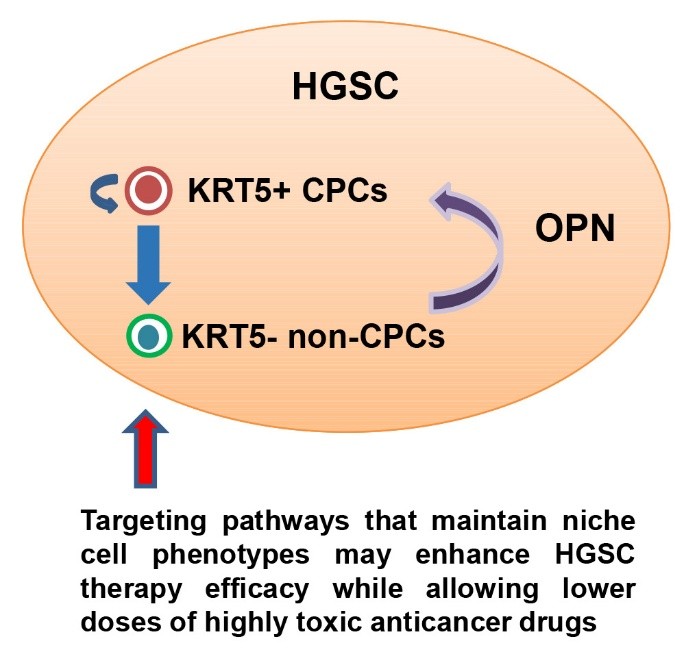
High-grade serous carcinoma (HGSC) is the most common and aggressive form of ovarian cancer. Advanced HGSCs exhibit pronounced cellular heterogeneity, including a subset of cancer-propagating cells (CPCs, also known as cancer stem cells) that are highly tumorigenic and display stem cell-associated properties such as self-renewal and chemoresistance. In contrast, a substantial fraction of HGSC cells is non-tumorigenic. The role of these non-cancer-propagating cells (non-CPCs) and their relationship to CPCs remain poorly understood. Here, we demonstrate that neoplastic cells expressing the intermediate filament protein keratin 5 (KRT5) represent bona fide CPCs. KRT5+ cells form cancer organoids over successive passages, are tumorigenic in serial dilution xenograft assays, and are resistant to the antineoplastic agents, doxorubicin and cisplatin. Single-cell lineage-tracing experiments show that KRT5+ CPCs give rise to KRT5- cells. KRT5+ and KRT5- populations exhibit distinct gene expression profiles, with KRT5- cells characterized by expression of SPP1, which encodes the secreted factor osteopontin (OPN). Treatment with OPN enhances HGSC organoid growth and chemoresistance, whereas SPP1 knockdown reverses these effects. Together, these findings support a model in which HGSC contains two hierarchically related cell populations: KRT5+, OPN-responsive CPCs and KRT5-, non-tumorigenic cells that form a niche producing OPN. Inhibiting pathways that sustain this niche may enable reduced dosing of highly toxic chemotherapeutic agents while enhancing therapeutic efficacy in HGSC.
KeywordsCancer cell niche, cancer heterogeneity, ovarian carcinoma, chemoresistance
Share this article




Copyright © 2026 Pivot Science Publications Corp. - unless otherwise stated | Terms and Conditions | Privacy Policy