Green Energy and Sustainability ISSN 2771-1641
Green Energy and Sustainability 2026;6(1):0002 | https://doi.org/10.47248/ges2606010002
Original Research Open Access
Boron Carbon Oxynitride (BCNO) as novel luminescent solar concentrator in greenhouse applications
Eirini Pitsika
1

 ,
Sofia A. Barla
2
,
George Salachas
2
,
Evangelos Giannakopoulos
2
,
Charis Stefanou
2
,
Theodosia Andrikopoulou
1
,
Elias Stathatos
1
,
Sofia A. Barla
2
,
George Salachas
2
,
Evangelos Giannakopoulos
2
,
Charis Stefanou
2
,
Theodosia Andrikopoulou
1
,
Elias Stathatos
1
Correspondence: Elias Stathatos
Academic Editor(s): Tony Roskilly, Georgios Martinopoulos, Georgia Kastrinaki, Hande Eryilmaz, Martin Roeb
Received: Oct 3, 2025 | Accepted: Jan 27, 2026 | Published: Feb 12, 2026
This article belongs to the Special Issue Selected Papers from the Conference ICRES 2025
Cite this article: Pitsika E, Barla SA, Salachas G, Giannakopoulos E, Stefanou C, Andrikopoulou T, Stathatos E. Boron Carbon Oxynitride (BCNO) as novel luminescent solar concentrator in greenhouse applications. Green Energy Sustain. 2026;6(1):0002. https://doi.org/10.47248/ges2606010002
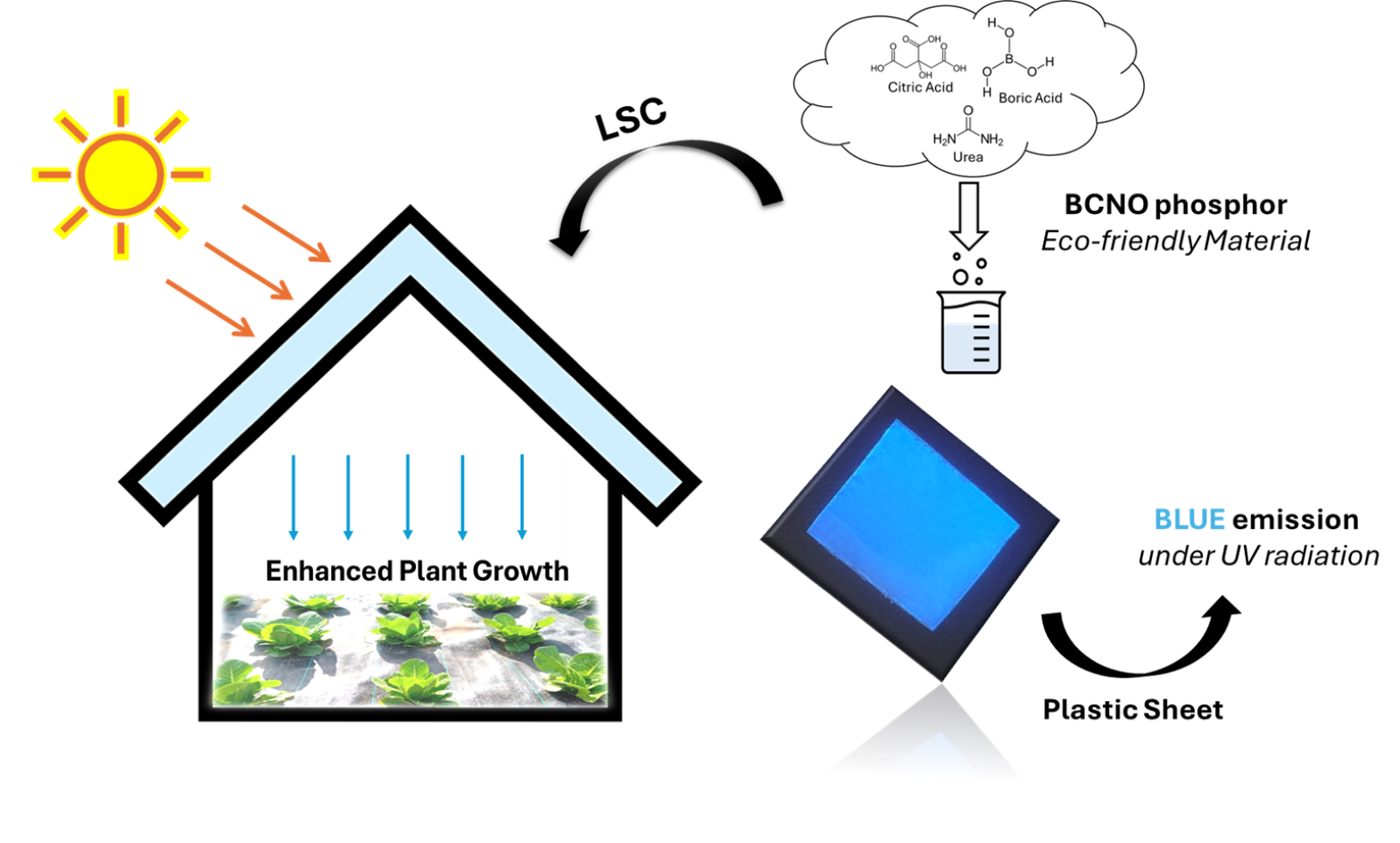
Luminescent Solar Concentrators (LSCs) have recently attracted attention for their dual role in boosting solar energy efficiency and enhancing greenhouse cultivation, offering a sustainable solution for agriculture and photovoltaics. The aim of this work is the synthesis and application of a new luminescent material as an LSC in greenhouses. Boron carbon oxynitride (BCNO) was synthesized and characterized as a new material with enhanced luminescent properties that could be useful in greenhouses to improve plant growth. The emission maximum of BCNO is located at 450 nm; therefore, it provides a targeted light increase at the first photosynthetically active peak of chlorophyll. Specifically, spectroscopic and structural studies were carried out to develop and optimize the material as a film, with the ultimate goal of depositing it on plastic surfaces that are commonly used in greenhouses. The BCNO film absorbs harmful UV light and converts it into strong blue light. The results were encouraging as they showed that the BCNO material, due to its high emission in the blue, can be used as LSCs in agriculture. The evaluation of BCNO as a solar concentrator was achieved in a small greenhouse with hydroponic lettuce crops. Two greenhouses were constructed, one of which had the BCNO material as a cover for the plastic shell. Compared to the control greenhouse, plants grown under the BCNO-coated cover exhibited a maximum increase of 16% in shoot fresh weight and 15% in dry biomass. Furthermore, total chlorophyll content was enhanced by up to 8.12%, while leaf gas exchange parameters showed notable improvements, with photosynthetic rates and stomatal conductance increasing by 7.34% and 11.11%, respectively compared to the control. These results indicate that materials such as BCNO are highly promising for optimizing and maximizing greenhouse crop yields.
Keywordsluminescent materials, luminescent solar concentrators, lettuce growth, greenhouses
Share this article




Copyright © 2026 Pivot Science Publications Corp. - unless otherwise stated | Terms and Conditions | Privacy Policy